

Dr Apaak Defends President Mahama’s Acceptance Of Honorary PhD
Deputy Minister of Education Dr Clement Abas Apaak has defended President John Dramani Mahama’s decision to accept an honorary doctorate degree, arguing that the award recognises his contributions to national development and was not something he demanded. Speaking on a current affairs programme, Dr
Ogyem Solomon
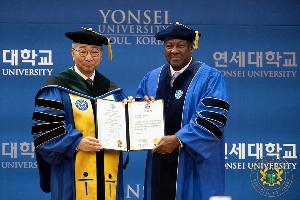
Deputy Minister of Education Dr Clement Abas Apaak has defended President John Dramani Mahama’s decision to accept an honorary doctorate degree, arguing that the award recognises his contributions to national development and was not something he demanded.
Speaking on a current affairs programme, Dr Apaak said that honorary degrees are often given to individuals whose work has had significant impact in particular fields or on society at large. He explained that President Mahama did not request the honour but was selected by an academic institution in recognition of his leadership and service.
According to Dr Apaak, many world leaders and notable public figures receive similar awards as a way of celebrating achievements and inspiring others. He said that such recognitions do not diminish the dignity of the recipient and instead highlight positive aspects of their careers.
Dr Apaak noted that critics of the honorary degree should consider the long record of initiatives and policies led by President Mahama that have had educational, economic and social impact. He argued that academic honours are not unusual for people who have served at the highest levels of national leadership.
He also emphasised that universities and colleges have the autonomy to confer honorary awards based on their own criteria, and such decisions are typically made independently of government influence.
Dr Apaak urged critics to focus on substantive issues affecting national development rather than reactions to ceremonial recognitions. He said that public debate should be centred on policies and programmes that directly affect citizens’ lives.
The remarks come amid discussions about the value and relevance of honorary degrees in contemporary society. Some members of the public questioned whether national leaders should accept honorary awards, while others see them as legitimate acknowledgements of service.
Dr Apaak’s comments have drawn mixed reactions, with supporters agreeing that academic recognitions can reflect genuine achievement, and critics urging greater scrutiny of how and why such awards are granted.
More Related Articles

WATCH: Police Officers in Bawku Threaten Resignation Over Deployment
Several police officers stationed in the Bawku enclave have reportedly threatened to resign from the Ghana Police Service unless they are transferred out of the area, citing safety concerns and the challenging security situation in the region. The development was highlighted by a Member of Parliamen

VIDEO: Man Narrates Two-Year Ordeal Under Alleged Kayamata Influence
A young Ghanaian man has shared a disturbing personal account of how he believes he lived under the influence of kayamata for more than two years, describing the experience as emotionally draining, financially destructive, and psychologically overwhelming. In his narration, the man claimed that a wo
Supreme Court Orders Attorney-General to Produce Ghana–US Deportation Agreement
The Supreme Court of Ghana has ordered the Attorney-General to present the deportation agreement between the Government of Ghana and the United States for judicial review. The directive forms part of an ongoing legal challenge questioning the legality, transparency, and constitutional basis of the a