

Ahafo NADMO Director Demands Disability Inclusion in Infrastructure and Disaster Risk Planning
The Ahafo Regional Director of the National Disaster Management Organisation (NADMO), Nana Adu Bonsu, has issued a strong call to all government institutions, private developers, and construction firms to prioritise disability inclusion in infrastructure development and disaster risk management plan
Dickson Boadi
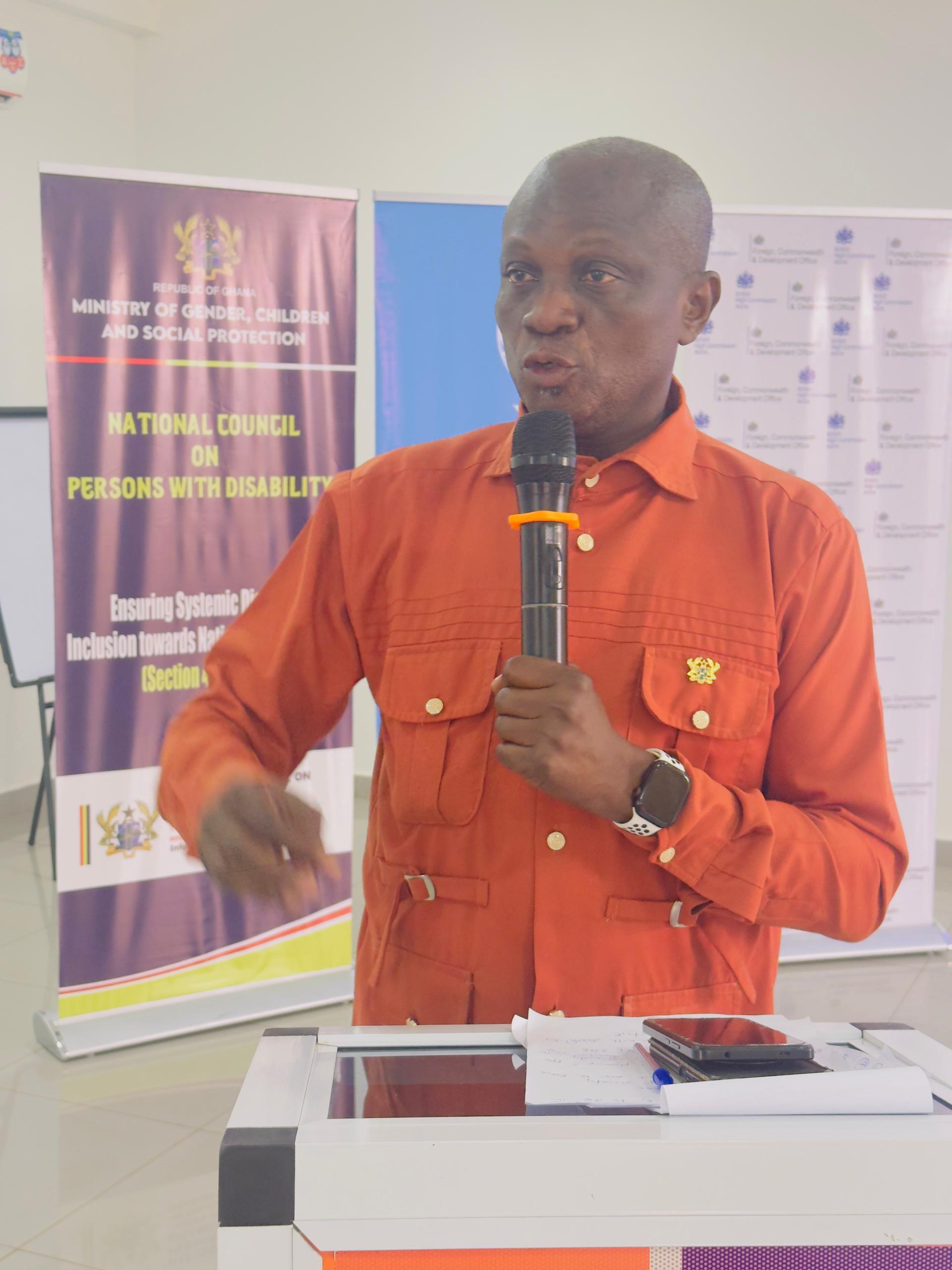
The Ahafo Regional Director of the National Disaster Management Organisation (NADMO), Nana Adu Bonsu, has issued a strong call to all government institutions, private developers, and construction firms to prioritise disability inclusion in infrastructure development and disaster risk management planning.
He made the call in Goaso at a sensitisation workshop on the Disability-Inclusive Disaster Risk Management Guidelines, organised by the National Council on Persons with Disability in partnership with the Ministry of Gender, Children and Social Protection and NADMO Headquarters.
The workshop brought together a broad range of key stakeholders involved in national security, emergency response, and public safety. Participants included personnel from the Ghana Armed Forces, the Ghana Police Service, the Ghana National Fire Service, the Ghana Immigration Service, and the Ghana Prisons Service, alongside officials from other public institutions, private developers, civil society organisations, and disability advocacy groups.
Addressing participants, Nana Adu Bonsu described disability inclusion as a legal, moral, and developmental obligation that must be reflected in both policy formulation and practical implementation.
“It is unacceptable that many government and private institutional buildings are still not disability-friendly. This situation exposes persons with disabilities to serious danger, particularly during emergencies,” he stated.
He explained that disasters such as floods, fires, and structural collapses often expose weaknesses in infrastructure design, with persons with disabilities suffering the most due to inaccessible environments.
“Disaster risk management does not begin when a disaster occurs. It begins from the planning and construction stages. If buildings are designed without ramps, accessible stairways, clear signage, and safe evacuation routes, then persons with disabilities are automatically excluded,” Nana Adu Bonsu said.
He stressed that inaccessible infrastructure not only violates disability rights but also complicates emergency response operations for security and rescue agencies.
“When emergency personnel struggle to evacuate persons with disabilities because buildings were poorly designed, lives are put at risk. Accessibility is therefore a safety issue, not just a social concern,” he added.
The Ahafo NADMO Director further urged institutions to integrate disability considerations into emergency drills, early warning systems, evacuation protocols, and relief distribution mechanisms.
Delivering the keynote address, Mr Joshua Addy, the National Representative on Persons with Disabilities, provided a detailed presentation on the various categories of disability and their specific implications for disaster preparedness and response.
“Disability is diverse, and disaster planning must recognise that diversity. A single approach cannot address the needs of all persons with disabilities,” he noted.
Mr Addy highlighted persons with physical disabilities, deaf persons, non-verbal persons, and individuals with communication disabilities, including speech and language impairments.
He explained that persons with physical disabilities often face severe challenges during evacuation due to stairs, narrow exits, and inaccessible shelters.
“For deaf persons, emergency alerts that rely solely on sound are ineffective. Visual signals, signage, and alternative communication methods are essential,” he explained.
He added that non-verbal persons and those with communication disabilities may struggle to understand emergency instructions if information is not simplified and clearly structured.
“If communication systems are not inclusive, confusion and panic increase during emergencies, and that can cost lives,” Mr Addy warned.
He emphasised that inclusive disaster risk management strengthens national resilience and enhances the effectiveness of security and emergency services.
“When we plan for persons with disabilities, we are not weakening our systems. We are strengthening them. Inclusive planning leads to safer communities for everyone,” he said.
Participants were taken through the practical components of the Disability-Inclusive Disaster Risk Management Guidelines, including inclusive infrastructure design, disability-sensitive communication, community engagement, and inter-agency coordination among emergency and security services.
The organisers called on all institutions, particularly security and emergency agencies, to move beyond awareness and ensure full implementation of the guidelines, stressing that inclusive planning before disasters strike remains the most effective way to protect lives and build resilient communities.
More Related Articles
Kumasi Metropolitan Assembly Fails to Elect Presiding Member After Two Rounds of Voting
The Kumasi Metropolitan Assembly (KMA) has failed to elect a Presiding Member after two consecutive rounds of voting, leaving the key leadership role vacant and sparking concerns about internal coordination among assembly members. The Presiding Member plays a crucial role in overseeing assembly proc
Senior High School Teacher Found Dead Under Mango Tree in Ghana
A 43-year-old senior high school teacher, identified as Abu Kabore, was found dead beneath a mango tree, sparking concern and an official investigation by the Ghana Police Service. The circumstances surrounding the teacher’s death remain unclear. Authorities have launched inquiries to determine the

Mother Says She May Have Put Son In Trouble In Lashibi Lynching Case
The mother of a young man arrested in connection with the lynching of a suspected thief in Lashibi says she fears her actions may have contributed to his arrest. The woman explained that her son was picked up by police after an incident in which a man accused of stealing was beaten and killed by &he